
Most business owners are managing a mix of rising costs, changing regulations, unpredictable markets and the need to deliver products and services customers want. Artificial intelligence can feel like yet another technological wave demanding attention and resources, but it is of concern not only to large companies with specialist teams and large IT budgets, but also small and medium sized enterprises (SMEs). This article provides an introduction to the practical use of AI by SMEs, to help them benefit from the potential of AI and achieve measurable goals.

Coping with rapid change and understanding AI related terminology, such as Vibe Coding, Dark Factory, AI Agents and Markdown, can feel overwhelming. Use of AI for tasks such as mining proposals, meeting notes, reports and guides, for useful information leaves many feeling under pressure to use AI in their own business. They might be inspired by AI generated knowledge bases for on-boarding and training, or AI finding valuable insights and leads in CRMs, emails, or sales and marketing reports, which they previously lacked resources to analyse.
Rather than replace existing IT systems, AI can provide an intelligence layer augmenting them. SMEs can use popular AI platforms for tasks such as interpreting sales data or summarising long reports, which are then proof read and edited by humans. It can find patterns in large data files, informing better decision making. However, AI is unlikely to solve all business challenges or replace entrepreneurial judgement. Oversight by human experts will be needed for setting goal, output evaluation, AI risk assessment and error correction during 2026 and beyond.
AI adoption could free staff from boring repetitive work, enabling them to focus on more strategic and creative thinking, but staff morale must be maintained. Therefore, communicate effectively that AI will assist rather than replace people. AI will be highly disruptive and society must find a workable solution for millions of people displaced from traditional roles. However, AI also provides an opportunity for individuals and SMEs with an effective AI roadmap to compete with larger organisations.
Using AI Within Existing IT Systems
To understand how AI can help an SME, it helps to start with a realistic picture of a typical SME technology environment. Most already rely on a mix of digital tools, with emails and documents managed using software suites such as Microsoft 365 or Google Workspace. Finance is often managed using accounting platforms such as Sage or QuickBooks. Customer relationships can be tracked in a CRM, while files are stored locally or on cloud servers and shared over networks.
For many SMEs, the most effective AI adoption strategy involves enabling AI within systems staff already use, such as Microsoft Copilot in Word, Excel, Outlook and Teams. For example, producing a summary of meetings held in Teams, with action points, or analysing Excel spreadsheets, to identify patterns that might otherwise remain hidden. Google Gemini could be used within tools people are already familiar with, such as Gmail, Google Docs and Sheets.
For SMEs with limited IT support, this approach avoids introducing another system that staff must learn. Using AI enables businesses to find patterns and identify issues, such as complaints in customer emails. Some routine enquiries could be answered by AI-powered chatbots. AI could also analyse marketing and sales funnels or assist in production of content, such as newsletters, though human proofreading and editing is recommended.
Before deciding which technology to use, a business should establish a strategy informed by clearly defined goals. Some tasks previously requiring specialist software can be automated using AI powered tools, such as improved analysis of data delivering actionable insights faster than manual processes. This could help an SME with limited resources become more competitive. However, some tasks are not suitable for automation with AI. For example, human judgement remains essential within strategic decision making and the building of customer relationships.
Comparing Popular AI Platforms
ChatGPT
Developed by OpenAI, ChatGPT, is among the most widely used AI tools and is a flexible general-purpose AI assistant, which can be used in a browser without the need for technical knowledge. It is used for research purposes, similar to a traditional search engine, content generation, summarising text, brainstorming ideas, drafting proposals or reports, analysing documents and for conversation. ChatGPT can be used as a standalone product, or connected to other systems, although integration with internal business systems would require additional setup.
Copilot
Copilot, developed by Microsoft is already within Microsoft 365, providing the businesses that use the suite of applications with built in AI capabilities. Working within Word, Excel, Outlook. PowerPoint and Teams, Copilot enables SMEs to more easily draft Outlook emails and Word documents, summarise meetings in Teams, analyse Excel spreadsheet data and generate PowerPoint presentations. If a business already uses Microsoft applications, Copilot could be the best way to begin making use of AI in their day to day operations.
Gemini
Developed by Google, Gemini is integrated within Gmail, Google Docs and Sheets. It has strong search and information capabilities, which could be used for tasks such as email and document drafting, analysing spreadsheets and summarising meetings. For an SME using Google Workspace it is integrated with tools they already use, but might not be as useful for businesses that rely primarily on Microsoft systems.
Claude
Developed by Anthropic, Claude has strong reasoning capabilities and excels at analysing, evaluating and summarising complex documents, such as contracts, policy information and lengthy research material. It is typically used alongside other productivity tools rather than replacing them. Claude can also assist with the coding of software, generated from written instructions, to develop custom business applications, which would be expensive and time consuming to deliver using teams of human software engineers.
An AI Roadmap for UK SMEs
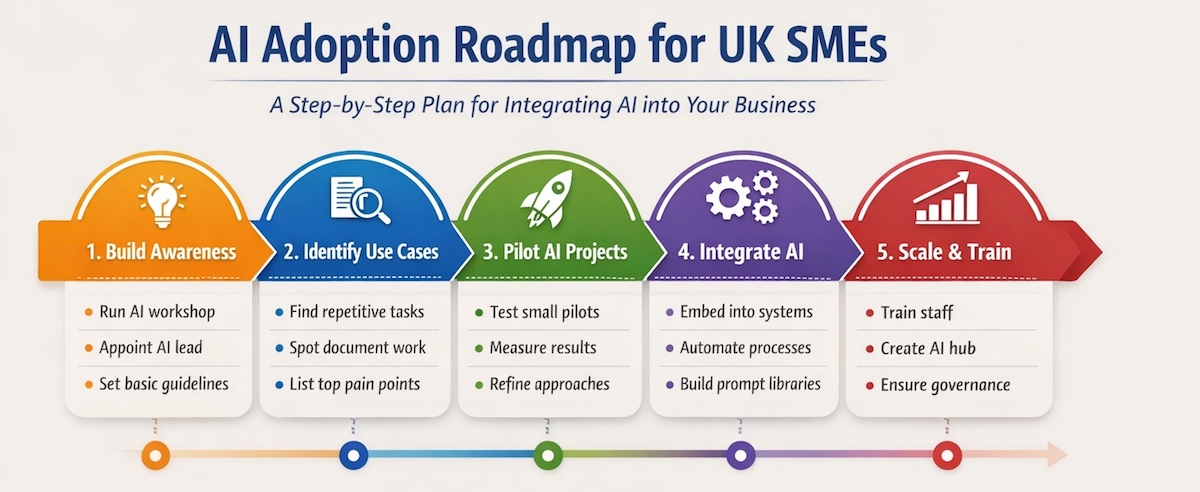
An AI roadmap should focus on productivity gains for an SME, rather than complex automation and build capability gradually across a business, by integrating AI with existing tools and workflows. The roadmap below outlines five stages an SME could follow over a period of weeks or months, according to their needs and resources.
Stage 1 – Build Awareness and Leadership Alignment
Appoint an internal AI lead to coordinate experimentation and learning across the business. Run AI workshops to gather information from departments such as; sales, marketing, finance, operations and customer services. Find tasks that are slow, time consuming, or involve repetitive work, such as searching for information. The aim is to identify opportunities to make efficiency gains, while complying with privacy and confidentiality requirements
Stage 2 – Identify High-Value Use Cases
Focus on processes where AI can quickly reduce manual work that is repetitive, document-heavy, data-driven and time-consuming. For example, drafting sales proposals, meeting summaries or FAQ guides, CRM data analysis, documenting processes and writing project, market research or financial report summaries. A business could ask staff to list time-consuming and repetitive tasks, some of which AI might be able to speed up.
Stage 3 – Launch Controlled AI Pilots
Before rolling out change across the whole business, run small pilot projects, which could involve some test use cases. AI tools could be evaluated according to how well they fit within current business IT systems and processes. For example, testing ChatGPT from OpenAI, Microsoft Copilot, Google Gemini and Claude from Anthropic. They could be used for tasks such as transcribing meetings, writing summaries, draft proposals and social media posts, or building an internal searchable knowledge base. Results can be measured, such as increased productivity, quality improvements, time saving, employee satisfaction and greater profitability..
Stage 4 – Integrate AI into Core Workflows
After identifying successful pilots, AI could be integrated more deeply into the daily operations of a business. For example, embedding AI into systems such as; Microsoft 365, Google Workspace, HubSpot, Salesforce, or QuickBooks. Sales and marketing teams could identify opportunities and summarise financial reports and proposals. AI could generate project plans, internal documentation and templates. Staff could contribute to a library of standardised AI prompts, to produce consistent results.
Stage 5 – Build Organisation-Wide AI Capability
Focus now shifts to building sustainable capability, with staff training in areas such as writing effective AI prompts, verifying outputs, using AI ethically and responsibly. An Internal AI Knowledge Hub could share useful prompts, case studies, best practices and approved tools, to accelerate learning across an SME. Policies should be formalised regarding data usage, security, compliance and audit trails. Governance and Security should also be aligned with legislation, such as the UK GDPR (General Data Protection Regulation).
Common AI Related Terminology
Vibe Coding
The term ‘vibe coding’ refers to software developed using AI to write code, in response to prompts describing what is required, rather than humans writing and editing code. This approach can assist rapid prototyping and creation of custom tools, but typically requires human oversight. Traditional software development involves highly skilled and experienced programmers using waterfall or agile methodologies. However, the rise of vibe coding has led many to ask whether AI will replace the need for human programmers.
The Dark Factory
The term ‘dark factory’ refers to fully automated production facilities that don’t need the lighting and heating human workers require. In relation to the process of software development, people provide AI with detailed instructions, typically written using Markdown. A business owner or manager can provide AI with instructions, as they might a team of software engineers. After AI has generated and tested the code, AI delivers the completed software. Performance can be evaluated and the software regenerated in an iterative process until it meets requirements.
Fully autonomous development is currently limited, but some elements of this approach are now used within a growing humber of businesses. This can enable SMEs with limited resources to create software rapidly and at a fraction of the usual cost, but human oversight generally remains to ensure reliability, security and compliance with regulations. However, some organisations are implementing the full dark factory model, in which staff are instructed to not touch the code, but focus on writing good specifications and then evaluate the finished product.
AI Agents
When integrated into business processes, AI agents can be used to automate multi-step tasks by interacting with software systems and data sources. An AI system could gather customer information, generate reports and send updates automatically, significantly reducing administrative workload. However, it is important to recognise the need for suitable controls and oversight, to prevent AI agents carrying out actions that prove detrimental. For example, deleting essential data, releasing private information or contravening regulations.
Markdown
It is important to provide AI with well structured instructions to produce desired outputs. Prompt engineering describes the process of entering natural language into AI in order to generate content such as text, images and audio. Markdown, a formatting language widely used in software development, provides a more precise approach to writing structured documents that humans and AI systems can interpret. A library of Markdown files could be built for use in a business.
AI performs better and produces fewer errors if given clear instructions in the form of well written specifications. Markdown provides a way of doing this and can be used for objectives such as; product descriptions, process documentation, operational procedures, or software projects. For example, the Markdown file specifications for computer code generation, could include; application purpose, expected inputs and outputs, data sources, constraints and requirements.
Markdown Guide
Structuring and styling text using Markdown symbols enables the writing of well organised instructions. For example, using # for headings and placing words between ** to make them bold. The free and open-source Markdown Guide provides instructions on the use of Markdown to format documents.
AI Risk Assessment
Although AI has the potential to transform business processes, risks associated with the use of AI should be considered. Rather than critical systems, it is advisable to begin by using AI for useful, but nonessential tasks. This will provide staff and management an opportunity to become familiar with capabilities and limitations of different AI platforms. AI can be a useful tool and assistant, but errors might prove expensive, particularly if they negatively impact delivery of products or services. Some clients might expect a discount if AI is used to complete a piece of work, reducing profits. There are also questions regarding the willingness of insurance companies to provide cover for processes that make use of AI.
AI During 2026 and Beyond
It has been reported that some AI projects failed to deliver hoped for benefits and might have even reduced productivity, though this could be due to poorly defined specifications and not aligning with clear business goals. Some believe AI will replace millions of workers, while others claim the bubble will burst. However, most accept that near and long term future impacts of AI cannot be predicted. For SMEs attempting to plan for the future, this presents a challenge. However, it can help to maintain a balanced perspective.
While some people prefer to wait and see regarding AI use, others state those who fail to adapt quickly will be replaced by those who do. They point to examples of past technological changes, such as digital media and the Internet, leading to businesses being displaced by new entrants, or competitors that used it more effectively. There are risks associated with over reliance on AI, such as ‘hallucinations’ and loss of skills, but many SMEs want to benefit from its use, rather than risk being left behind. Approaching AI as a tool or resource that is useful for certain tasks as we try to achieve business goals could help SMEs benefit from its use, while avoiding some of the potential pitfalls.