
Contemporary Arts and Crafts Movement
CraftBook Magazine emerged from my experience working in the technology sector and an interest in the Arts and Craft Movement, which was a response to the impact of industrialisation taking place in nineteenth century Britain. The movement influenced hand-made arts, crafts and design, but was also motivated by deeper concerns about human society. The Internet, artificial intelligence and robotics are causing similar concerns in the twenty-first century.
Animated introduction transcript
- Making and Meaning. CraftBook Magazine. A contemporary take on the Arts and Crafts Movement
- Same old problems. An Old Question, Asked Again. 1851 and the 2020s, both asking what human work is for
- Pugin, Ruskin and Morris. Making Things Matters. Have nothing in your houses that you do not know to be useful, or believe to be beautiful
- Not a rejection of technology. Machines Have Their Place. For the repetitive work, never for the creative human element
- Business. Earning a Living. Digital and email marketing for freelancers and small businesses
- Communication. Making Ourselves Understood. Copywriting and the craft of being understood
- Creativity. Making Things. In an age of generative AI, human creativity becomes rarer and more valuable
- Society. How We Live. Philosophy, mythology and the stories we tell about ourselves
- Technology. The Tools We Use. Understanding the technology shaping how we live and work
- Interactive. Understanding Through Making. Infographics, games, a personality test and a story maker
- The CraftBook Guide. Ask, and Discover. A conversational guide to everything on the site
- The path we choose. Making and Meaning. CraftBook.co.uk. Free eBook: Creative Intelligence
William Morris
Rather than restrict themselves to one area of study, followers of the Arts and Crafts Movement frequently had wide ranging interests. For example, William Morris studied architecture, but became a designer and printer, ran businesses and debated politics and economics. Morris co-founded Kelmscott Press, wrote novels and poetry, learned Icelandic and translated Norse sagas, influencing future generations of fantasy authors. What unified his work was a common philosophy.
Understanding Through Making
The Arts and Crafts Movement promoted the value of understanding the whole process of how something is made, rather than only a small part. Taking a contemporary approach, I have designed interactive infographics, that can be assembled to show how the parts make the whole and educational games. I also write about business, communication, creativity, society and technology, and have written books, including the eBook Creative Intelligence, which is free to download.
Different World Same Old Problems
Rather than purely nostalgic, the Arts and Craft Movement viewed traditional arts and crafts, as practiced by skilled artisans, as way of continuing something of value to society. The philosophy behind the movement was applied to issues as varied as health, education, architecture, town planning, the environment, economics, politics and business. For example, through worker co-operatives. Many of its followers explored themes found in mythology, which was often reflected in their work.
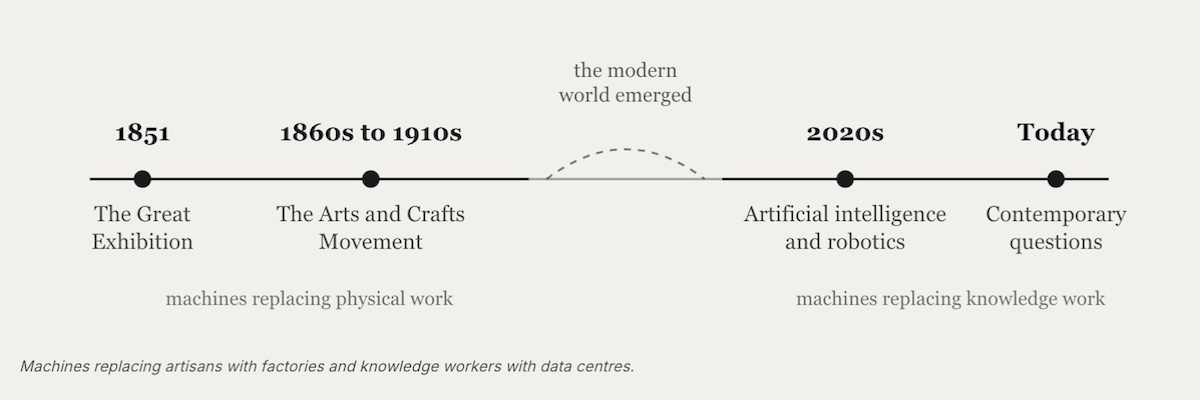
Three formative figures in the Arts and Crafts Movement were Augustus Pugin, John Ruskin and William Morris. Pugin promoted using materials in a manner that suited their purpose. John Ruskin thought mass production factory work, in which each person repeated set tasks, to be damaging to human well being. He believed people should be involved at each stage of the design and making of an item. William Morris became famous for his work as a designer, but he regarded the process of making as essential to a healthy life and society.
It might be thought that the Arts and Crafts Movement was opposed to all use of technology. However, Morris and others involved in the movement were open to the use of machines, but they should not replace the creative human element. For example, an artist and artisan could design a piece of work and be involved in the entire production process, but use machines for some repetitive and time consuming parts of the process. The debate then, as today, was around the value and meaning of work and individual agency.
The objection was not to the use of machines, but that they should benefit all, rather than only the wealthy few.
Economic Reality
Most of us must deal with the practical reality of needing to earn a living, but AI and robotics are increasingly taking on tasks previously done by people. This is causing many to fear their current skills and experience might no longer enable them to find employment. There is widespread discussion of whether all human labour, both physical and mental, might be done by machines in the near future.
The Industrial Revolution left many skilled artisans unable to compete with the production speed and lower costs of mass produced goods. It can be argued that by the twentieth century industrialisation and mass production brought tangible benefits to the lives of working and middle class people. New jobs eventually emerged, but many who lived through the decades of disruption were unable to adapt. Some fell into generational poverty and societal instability spread.
Where changing technology in the past impacted employment opportunities for the agricultural and industrial working class, AI is causing more concern among knowledge workers. Also while factories took decades to build and the process of change took place across generations, AI can disrupt current business models far more rapidly. This makes education and training to prepare and adapt to such change more challenging.
The dilemma the Arts and Crafts Movement failed to adequately solve, was that although the higher quality of hand made arts and crafts appealed to people, it could not compete on cost with mass production. The wealthy few could afford to purchase the work created by highly skilled artists, designers and artisans, but most bought lower priced alternatives they could afford. However, the ideals of the philosophy behind the movement still inspire creatives in many disciplines.
People value unique hand made items, whether for status or aesthetic reasons, even though they frequently purchase mass produced items for reasons of cost or practicality. Perhaps in our search for a solution to this dilemma, we might find some answers by following the William Morris quote: ‘Have nothing in your houses that you do not know to be useful, or believe to be beautiful.’
The Path We Choose
Some believe this period of rapidly changing technology will lead to a utopian future while others fear a dystopian nightmare. None of us know where society is headed, but choices made during the coming months and years will shape that future. If many cede their skill and judgement to machines, the ability to think for yourself could become a valuable asset.
Hopes and fears described in accounts of people living through the Industrial Revolution are similar to those expressed today regarding the Internet, AI and robotics. Although the technology differs and many of societies expectations have changed, human nature remains the same. We might learn something by understanding the past, such as the response of people involved in the Arts and Crafts Movement when the world around them went through rapid change.
It has been said the journey is often more important than the destination. In a similar manner, we might not know the answers, but we should all be asking questions and discussing the use of technology. We should call for decisions to be made based on good judgement, rather than ignorance, greed or narrow self-interest. I hope what I write, create and add to CraftBook Magazine during my journey contributes something of value to that conversation.
You might like to read the article The Arts and Crafts Movement, where I explore the movement in greater depth.
Paul Riley